I’m Cheng Zuwei, with a master’s degree in spinal surgery from the Fourth Military Medical University.
Before starting the company, as an orthopedic surgeon, I saw too many patients with cervical spine problems — from twenty-something desk-bound programmers whose “necks were already broken,” to office workers with recurrent cervicogenic headaches, to fitness enthusiasts with post-workout neck discomfort.
Their X-rays appeared normal — no disc herniation, no fractures, no obvious structural pathology. But they were in pain, sometimes even affecting their balance and body control in daily life.
My orthopedic experience, combined with discussions with military sports medicine experts, became the starting point for HulaNeck: neck health is far more complex than the alignment of bones. It depends on a group of small, often overlooked muscles — the Deep Cervical Flexors (DCF).
🔬 Extensive Research Shows: The DCF — The “Core” of the Neck
What Are the Deep Cervical Flexors?
The Deep Cervical Flexors (DCF) include muscles such as Longus colli, Longus capitis, and Rectus capitis anterior. Located deep in the neck, close to the front of the vertebral bodies — unlike the prominent sternocleidomastoid, these small muscles are the true foundation of cervical spine stability.
The primary function of the DCF is to span across vertebrae, maintain the cervical lordosis, and provide segmental stability during dynamic movement — just as the core muscles support the lumbar spine, the DCF acts as the “core stabilizer” of the cervical spine. — McDavid & Khan, Anatomy of Prevertebral Muscles, NCBI
🧩 Finding: DCF Function Is Significantly Reduced in Neck Pain Patients
In 2004, Falla and Jull’s team demonstrated through precise EMG studies:
“Neck pain patients show significantly reduced EMG activity in the deep cervical flexor muscles during the craniocervical flexion test compared to healthy controls.” — Falla D, Jull G, et al. Spine, 2004
In simple terms: when your neck hurts, the DCF isn’t too weak — it’s “slacking off.”
Jull’s team’s 2009 RCT brought a counterintuitive finding:
“Low-load craniocervical flexion training can restore DCF activation patterns and improve cervical postural stability; conventional high-load strength training fails to improve DCF activation.” — Jull GA, Falla D, Vicenzino B, Hodges PW. Manual Therapy, 2009
Conclusion: The key to cervical training is not how much force you can generate, but how precisely you activate and control those deep small muscles.
📚 Systematic Reviews Confirm: Training the Right Muscles Matters More Than “Strength”
In 2020, Tsiringakis et al. published a meta-analysis covering 17 studies:
“Motor control training of the DCF significantly outperforms traditional strength-endurance training in reducing neck pain and improving dysfunction (pain: Hedges’ g=0.323; dysfunction: Hedges’ g=0.401).” — Tsiringakis G, et al. Musculoskeletal Science and Practice, 2020
Blomgren, Jull et al.’s 2018 systematic review further confirmed:
“Strong evidence indicates that DCF training improves neuromuscular coordination and head-neck posture.” — Blomgren J, Jull G, et al. BMC Musculoskeletal Disorders, 2018
⚖️ Multiple Studies Show: Neck Function Directly Affects Whole-Body Balance
The neck is not merely a support structure for the head — through its rich proprioceptive organs, it participates in whole-body balance and motor control.
“Cervical stabilization training combined with proprioception training significantly improves balance function and postural alignment in individuals with forward head posture.” — Özalp M, Kayabınar E, Talu B. BMC Musculoskeletal Disorders, 2025
“After induced cervical flexor fatigue, subjects’ neck proprioception and postural stability significantly decreased. Neck fatigue directly impairs the body’s ability to maintain balance.” — Decreased Neck Proprioception and Postural Stability After Induced Cervical Flexor Muscles Fatigue, PMC7493440
“Cervical sensorimotor control is the second most modifiable risk factor for concussion. Every 10% increase in cervical joint position error is associated with a 5% increase in concussion rate.” — Farley et al., 2022
🛡️ Research Shows: Neck Strength Is a Protective Factor Against Concussion
“Neck strength is a protective factor reducing concussion risk in high school athletes. Each 1-pound increase in neck strength reduces concussion risk by approximately 5%.” — Collins et al., 2014
The 2023 SIRC (Sports Info Resource Centre, Canada) report further identified adolescents, females, and individuals with forward head posture as three high-risk groups with weaker neck strength and higher concussion risk.
💡 Current Neck Training Methods
Current neck training methods can be broadly categorized as follows:
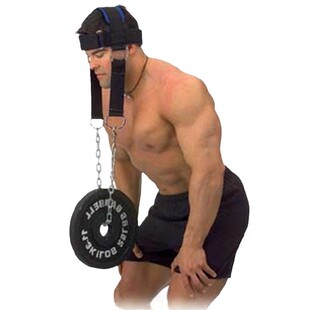
Weighted Head Harness: Attaching weight plates to the head for training. Low cost, but the weight swings unstably during movement, and it only allows forward/backward flexion-extension without training rotational or lateral DCF control.
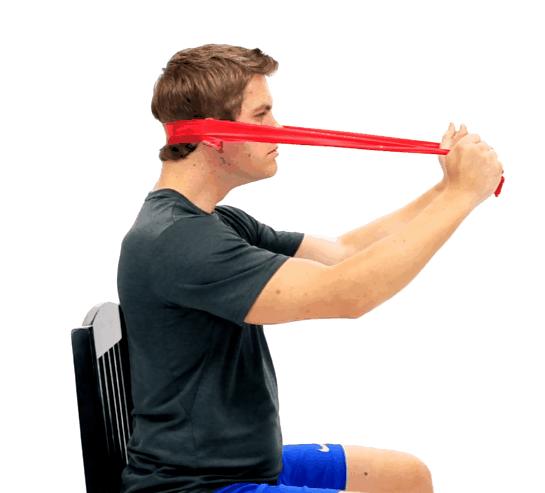
Resistance Band Neck Trainers: Using bands to provide 360° resistance. Effective, but require an anchor point — usable only at home or in the gym. Moreover, bands primarily provide high-load training, which is excessive for the low-load precision control needed in rehabilitation and daily maintenance.
Isometric Training: Using hands or equipment for static resistance against the head. Safe for rehabilitation, but only trains strength at specific angles without developing neuromuscular coordination during dynamic movement.
Clinical Rehabilitation Methods: Craniocervical flexion training using pressure biofeedback units. Precise, but requires professional equipment and therapists — patients cannot perform it independently at home.
Each method has its value, but they share a common limitation: they either require external anchors or equipment, can only train in a single plane, or cannot be integrated into daily life.
🤝 Exploring with Professor Shao — A Military Sports Medicine Expert
In 2023, after the pandemic, I began exploring the DCF with Professor Shao, a military sports medicine expert. As early as 2019, he had conducted neck protection research for naval aviation carrier-based pilots — during carrier landings, pilots’ necks endure 3-4 violent whiplash cycles at high deceleration, making whiplash the most common occupational injury.
Professor Shao’s idea was direct: could we wear a ring-shaped water bladder on the head, using the inertia of water to create dynamic resistance, training the neck’s small stabilizing muscles for impact resistance? He filed a utility model patent (CN 210472951 U) and built the first prototype.
The water solution was simple and safe — but its physical limitations were clear: achieving 2.5kg of training resistance would require about 5 liters of water, making the device very large. Water also evaporates, causing unstable resistance over long-term use.
But the question wouldn’t let go.
🌊 HulaNeck WaveRing: From Clinical Insight to Product
Iterative Exploration and Testing
Drawing on clinical experience and academic understanding of the DCF, my team and I kept experimenting and testing various approaches:
The DCF needs dynamic, low-load, multi-directional neuromuscular control training — not the brute force of resistance bands or static isometric contractions.
In the end, we chose specially manufactured miniature stainless steel balls.
Steel Balls: More Than Just Weight
Replacing water with steel solved three key problems:
- Density Advantage: Steel density ≈ 7.8 g/cm³, 7.8× that of water. The volume for 2.5kg of resistance shrank from 5L to about 0.3L.
- Proprioceptive Feedback: Steel balls rolling in air are more predictable than water sloshing in liquid — the user can perceive the position and momentum of the balls, which itself trains neck proprioception.
- An Unexpected Bonus: White Noise: The sound of steel balls rolling in a flexible tube closely resembles waves lapping on a beach — a relaxing natural white noise.
How It Works
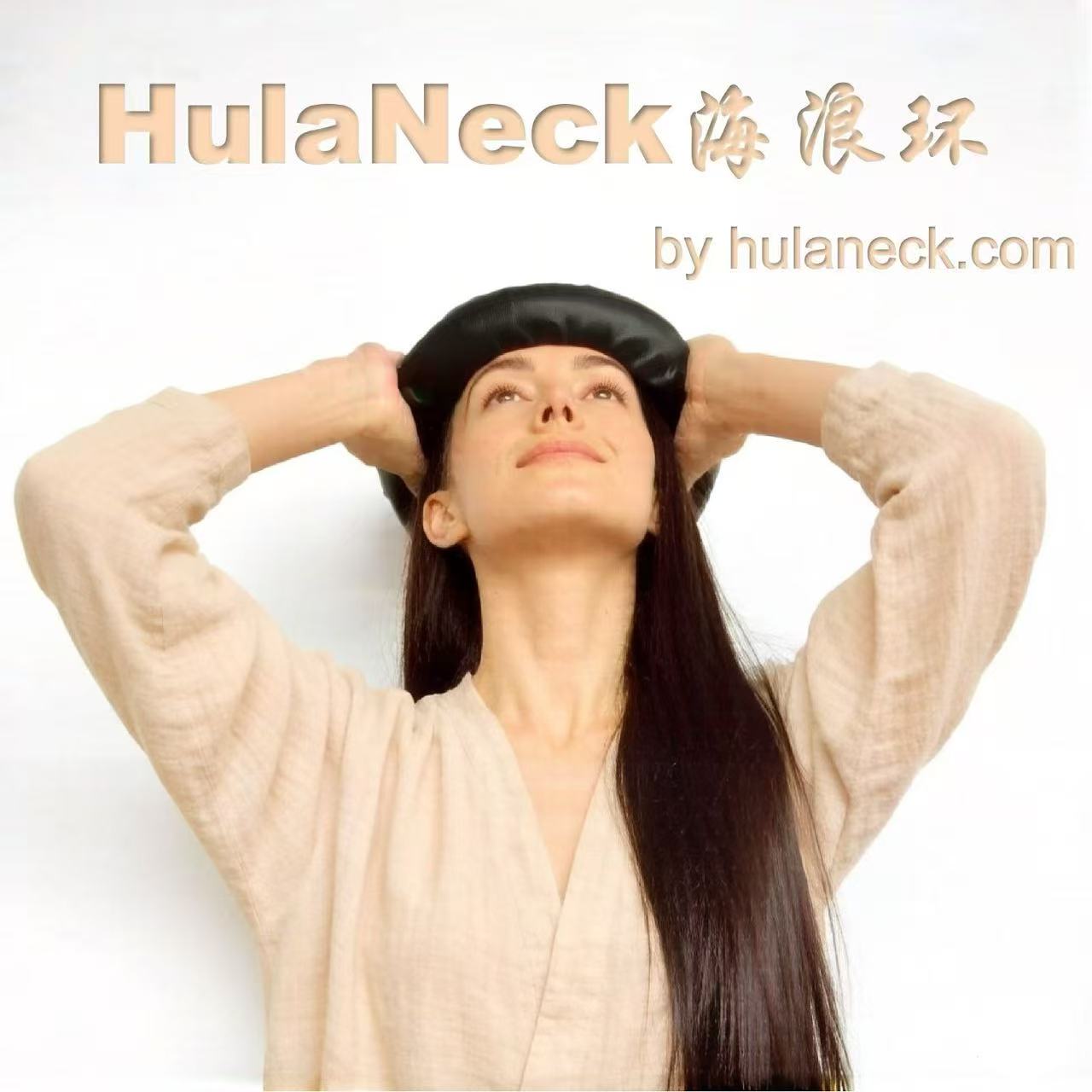
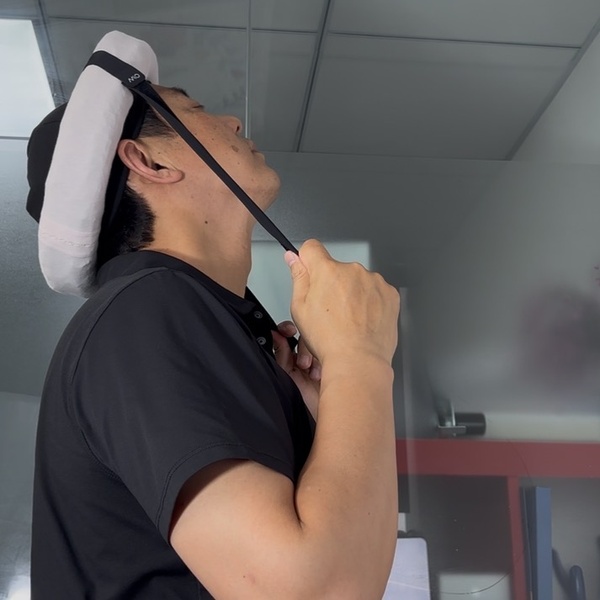
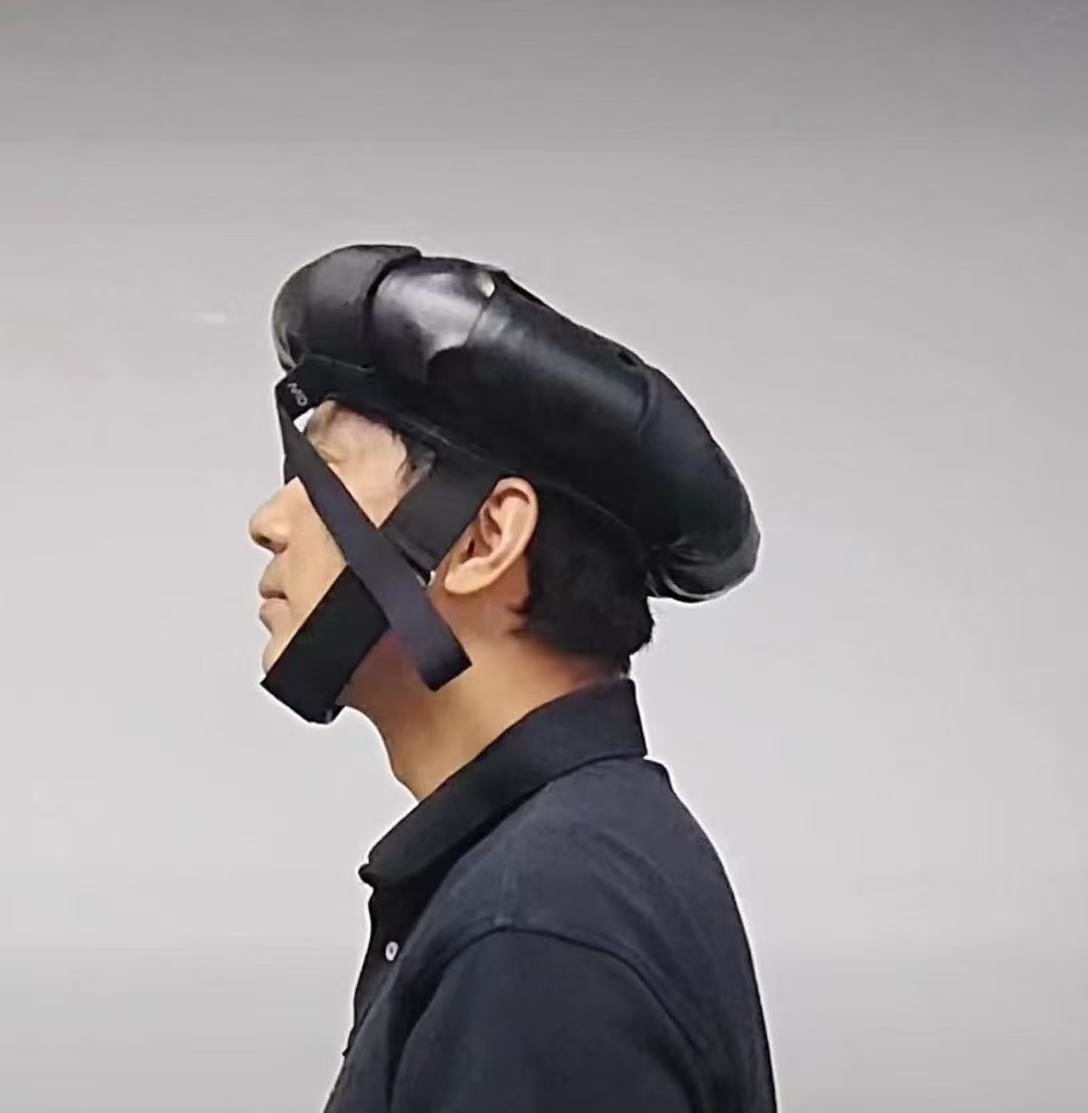
HulaNeck WaveRing’s core structure includes: a ring-shaped flexible transparent tube (with metal spiral reinforcement), a precise quantity of small-diameter steel balls inside, and a head fixation assembly (fabric straps + chin strap).
When the wearer rotates or swings their head at a specific rhythm and amplitude, the steel balls inside the ring are driven by centrifugal force and gravity, creating a continuous rolling motion. This produces an inertial force opposite or perpendicular to the head movement — this dynamic load is exactly what the DCF must respond to and resist in real time.
Because the direction, speed, and impact of the steel balls are entirely controlled by the wearer’s own movement, this is a closed-loop, adaptive dynamic training system — the more precise the movement control, the smoother the ball flow; the more vigorous the movement, the greater the impact force.

Use Scenarios
- 💻 Office Workers — Neck Relaxation: Slow head swinging after prolonged sitting to stretch and release neck-shoulder fascia
- 🏃 Athletes & Pilots — Impact Resistance Training: Using the 3+3 training method to improve cervical stability, balance, and impact resistance
- 🧘 Meditation & Sleep Aid: Wave-like white noise combined with gentle head movement for deep mental relaxation
- 🦢 Posture & Swan Neck: Stretching and training for a more elegant neck silhouette
- 🧠 Brain-Computer Interface Platform: Future integration of sensor modules for quantified neck training and biofeedback


Science-Meets-Product Correspondence
| Academic Requirement | HulaNeck Solution |
|---|---|
| DCF needs low-load, precise motor control training (Jull, 2009) | Adjustable steel ball mass, controllable training rhythm |
| DCF training improves neuromuscular coordination and posture (Blomgren, 2018) | Continuous dynamic feedback requires real-time movement adjustment |
| Cervical proprioception training improves balance (Özalp, 2025) | Steel ball rolling position provides immediate proprioceptive feedback |
| Neck strength protects against concussion (Collins, 2014) | Gradually increasing steel ball mass for progressive overload |
| Cervical stability requires impact resistance | Centrifugal force of steel balls simulates dynamic impact loads |
📖 References
- Falla D, Jull G, et al. Neck pain patients demonstrate reduced activation of the deep neck flexor muscles during performance of the craniocervical flexion test. Spine, 2004.
- Jull GA, Falla D, Vicenzino B, Hodges PW. The effect of therapeutic exercise on activation of the deep cervical flexor muscles in people with chronic neck pain. Manual Therapy, 2009;14(6):696-701.
- Blomgren J, Jull G, et al. Effects of deep cervical flexor training on impaired physiological functions associated with chronic neck pain: a systematic review. BMC Musculoskeletal Disorders, 2018.
- Tsiringakis G, Dimitriadis Z, et al. Motor control training of deep neck flexors with pressure biofeedback improves pain and disability in patients with neck pain: A systematic review and meta-analysis. Musculoskeletal Science and Practice, 2020;50:102220.
- Özalp M, Kayabınar E, Talu B. Assessment of the effects of cervical stabilization exercises and proprioception training on balance and posture in individuals with forward head posture. BMC Musculoskeletal Disorders, 2025.
- Decreased neck proprioception and postural stability after induced cervical flexor muscles fatigue. PMC/PubMed (PMC7493440).
- Collins et al. Neck Strength: A Protective Factor Reducing Risk for Concussion in High School Sports. 2014.
- Farley et al. Cervical Joint Position Error Test in professional rugby players. 2022.
- SIRC (Sports Info Resource Centre). Prevention of sport-related concussions through neuromuscular neck strengthening. Canada, 2024.
- Shao Lin, et al. A helmet-type neck proprioceptive strength training device. CN 210472951 U, 2019.